top of page

Sources:1. Borla, Mathilde : Les Statuettes Funéraires du Musée Égyptien de Turin In: Dossiers d'Archeologie
2003
2. KMT, vol. 14, pt. 1
3. Meskell, Lynn: Intimate archaeologies : the case of Kha and Merit. IN: World Archaeology, Vol. 29,
No. 3, Intimate relationships (Feb. 1998), p. 363-379.
4. Shaw, Ian, Nicholson, Paul: British Museum dictionary of ancient Egypt
London: British Museum Press, 1995.
5. Reeves, Nicholas: Ancient Egypt : the great discoveries : a year-by-year chronicle
London : Thames & Hudson, 2000.
6. Vassilika, Eleni: The tomb of Kha : the architect
Torino : Fondazione Museo delle Antichita Egizie, 2010.
7. Russo, Barbara: Kha (TT 8) and his colleagues : the gifts in his funerary equipment and related
artefacts from Western Thebes
London : Golden House Publications, 2012.
8 https://arxiv.org/ftp/arxiv/papers/1107/1107.5831.pdf
9. Raffaella Bianucci, Michael E. Habicht, Stephen Buckley, Joann Fletcher, Roger Seiler, Lena M.
Öhrström, Eleni Vassilika, Thomas Böni, Frank J. Rühl. "Shedding New Light on the 18th Dynasty
Mummies of the Royal Architect Kha and His Spouse Merit", in PLOS-One, July 22, 2015
http://journals.plos.org/plosone/article?id=10.1371/journal.pone.0131916
Images of Deir el-Medina:
past & present
Egypt Centre, Swansea University, Wales
The Egypt Centre is not a widely known museum and we were delighted to see that the collection is large and varied, with interesting and beautiful objects ranging from the painted coffin of a female musician from Thebes, beautiful beaded necklaces from the time of Tutankhamun, statues of gods and goddesses, to everyday objects used by the ancient Egyptians such as tools, pottery and weapons. There are around 6000 objects in the collection. Most were collected by the pharmacist Sir Henry Wellcome. Others come from the British Museum, Aberystwyth University, the Royal Edinburgh Museum, the National Museums and Galleries of Wales Cardiff, the Royal Albert Museum and Art Gallery, Woking College and private donors.
Sir Henry Wellcome collected objects from excavations. The Egypt Centre's collection includes objects from Armant, Amarna, Deir el-Medina, Esna, Mostagedda, Qau etc. He also collected objects from private individuals. These include Robert De Rustafjaell, Gayer-Anderson, Berens, Cesnola, the Rev. William Frankland Hood and the Rev. William MacGregor
https://www.egypt.swan.ac.uk/

Painted plaster from the tomb of the craftsman Khabekhnet and his wife Saht (both right). They are worshipping the gods Isis, Ptah Sokar wearing the headdress and Ptah depicted in green (from left to right).
From Deir el-Medina
Limestone, plaster, pigment
New Kingdom, 19th dynasty, reign of Ramesses II
Accession Number W927
Height: 44.5 cm
Width: 69.5 cm
Currently on display on the ground floor - House of Death
Davies, Benedict G. 1999. Who's who at Deir el-Medina: a prosopographic study of the royal workmen's community. Egyptologische Uitgaven 13. Leiden: Nederlands Instituut voor het Nabije Oosten. [pp. 44–47]

From the EC website unchanged: Painted limestone relief depicting Khabekhnet and his wife Sahte (to the right) presenting offerings to the gods Ptah (painted green), Ptah-Sokar (wearing a headdress consisting of ram horns and double plumes), and Isis (holding a menat-collar and ankh). Both Ptah and Ptah-Sokar hold long papyrus stems. Several enthroned deities are also depicted in the scene above, although only their feet are preserved. Khabekhnet is identified in the hieroglyphs as the “Servant of the Lord of the Two Lands”. The exact provenance of this relief is unknown, although it is likely from a tomb chapel at Deir el-Medina where Khabekhnet was buried (TT 2). Khabekhnet was the eldest son of Sennedjem, whose well-known tomb (TT 1) at Deir el-Medina was discovered undisturbed in 1886. While Ptah was the main deity at Memphis, he was also the patron god to the villagers of Deir el-Medina. The relief was purchased by Sir Henry Wellcome in 1906 from the collection of Robert de Rustafjaell (lot 404). The object is composed of three fragments, which were restored and conserved by Susan Rees at Cardiff Conservation Department.
Offering stand of Paneb
From Deir el-Medina
Limestone
New Kingdom, 19th dynasty, reign of Ramesses II or Siptah
Acc. Number W957
Height: 43.0 cm
Width: 26.9 cm
Depth: 26.5 cm
Currently on display on the 1st floor - House of Life
https://egyptcentre.abasetcollections.com/Objects/Details/3106?SavedSelections=$Page-1$Pn-P_63-e
From the EC copied: Limestone base of an offering table belonging to Paneb, Chief Workman at Deir el-Medina, the village occupied by workmen who built the royal tombs in the Valleys of the Kings and Queens. The stand was probably set up in one of the small private chapels adjoining the village. The vertical text on the front is a dedication of offerings to Amun. The horizontal text records the name of his father Neferseret and son Aapahte. On the rear is a dedication to Khnum, Satet, and Anuket, gods of the First Cataract region, who were held in particular honoured by the workmen at Deir el-Medina. According to Papyrus Salt 124, which is housed in the British Museum, Paneb lived a wild and disreputable life. He was given to fighting and drunkenness, seducing married women, stealing from the royal tombs, and threatening to murder. The object was purchased by Sir Henry Wellcome from the 1907 sale of the Robert de Rustafjaell collection. On loan to the Egypt Centre since 1971 as part of the distribution of the Wellcome collection. For similar offering table bases from Deir el-Medina, see Bruyère 1948 (p. 103); 1952 (pl. 21); 1952b (p. 42, fig. 2). The chief workman Paneb, son of Nefersenut, is well known from several sources (c. 1150–1193 BC). He is first attested as a workman in year 66 of Ramesses II. He began to prepare Tomb 211 when still a workman. He became chief workman between years 1 and 5 of Seti II and is last attested in office in year 2, probably of Siptah. He was most likely disgraced and removed from office at the end of the Nineteenth Dynasty, although the exact date is uncertain (Sweeney 2023).
Bruyère, Bernard 1948. Rapport sur les fouilles de Deir el Médineh (1935–1940). Quatrième partie. Fascicule I. Fouilles de l'Institut Français d'Archéologie Orientale 20 (1). Le Caire: L'Institut français d'archéologie orientale. Bruyère, Bernard 1952a. Rapport sur les fouilles de Deir el Médineh (1935–1940). Quatrième partie. Fascicule II: trouvailles d'objets. Fouilles de l'Institut Français d'Archéologie Orientale 20 (2). Le Caire: L'Institut français d'archéologie orientale. Bruyère, Bernard 1952b. Rapport sur les fouilles de Deir el Médineh (1935–1940). Quatrième partie. Fascicule III: notes à propos de quelques objets trouvés en 1939 et 1940. Fouilles de l'Institut Français d'Archéologie Orientale 20 (3). Le Caire: L'Institut français d'archéologie orientale.
Sweeney, Deborah 2023. Builders behaving badly: the rise and fall of the chief workman Paneb (i) at Deir el-Medîna. Journal of Egyptian Archaeology 109 (1–2), 117–129.
Ostrakon with a representation of Hathor in the form of a cow
New Kingdom 1550-1069 BC


The goddess of love, music and drunkenness, Hathor is depicted in the form of a cow on this piece of pottery.
New Kingdom 1550-1069 BC
Ostrakon written by Nakhtamun to his brothers Khay and Baki concerning their ill father Nebre (circa 1279-1069 BC)
From Deir el-Medina
Limestone
New Kingdom 1550-1069 BC
Rob Demarée, "Fresh goose-fat to cure a nightmare?"
(17 April 2024)
https://oap.unige.ch/journals/bseg/article/view/1547/1456

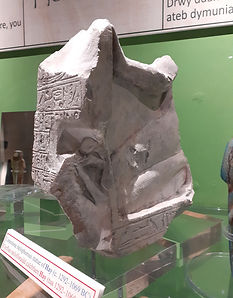


Stelophorous statue of Hay (c. 1292-1069 BC)
Limestone
New Kingdom 1550-1069 BC
Stela depicting Thoth in the shape of a baboon
New Kingdom 1550-1069 BC
bottom of page