top of page

Sources:1. Borla, Mathilde : Les Statuettes Funéraires du Musée Égyptien de Turin In: Dossiers d'Archeologie
2003
2. KMT, vol. 14, pt. 1
3. Meskell, Lynn: Intimate archaeologies : the case of Kha and Merit. IN: World Archaeology, Vol. 29,
No. 3, Intimate relationships (Feb. 1998), p. 363-379.
4. Shaw, Ian, Nicholson, Paul: British Museum dictionary of ancient Egypt
London: British Museum Press, 1995.
5. Reeves, Nicholas: Ancient Egypt : the great discoveries : a year-by-year chronicle
London : Thames & Hudson, 2000.
6. Vassilika, Eleni: The tomb of Kha : the architect
Torino : Fondazione Museo delle Antichita Egizie, 2010.
7. Russo, Barbara: Kha (TT 8) and his colleagues : the gifts in his funerary equipment and related
artefacts from Western Thebes
London : Golden House Publications, 2012.
8 https://arxiv.org/ftp/arxiv/papers/1107/1107.5831.pdf
9. Raffaella Bianucci, Michael E. Habicht, Stephen Buckley, Joann Fletcher, Roger Seiler, Lena M.
Öhrström, Eleni Vassilika, Thomas Böni, Frank J. Rühl. "Shedding New Light on the 18th Dynasty
Mummies of the Royal Architect Kha and His Spouse Merit", in PLOS-One, July 22, 2015
http://journals.plos.org/plosone/article?id=10.1371/journal.pone.0131916
Images of Deir el-Medina:
past & present
Neues Museum, Berlin, Germany
The Berlin Museum and the German Orient Society (Deutsche Orient-Gesellschaft) were granted a concession to excavate
at Western Thebes during 1911-1913. Their work at Deir el-Medina was conducted under the leadership of Georg Möller,
a distinguished paleographer, between the 26th February and the 29th March 1913. Their dig covered 4 locations and resulted in numerous finds: more than 160 hieratic ostraka and 70 figured ostraka were recovered. 11 houses together with their contents were uncovered and within the Eastern cemetery 4 graves of children were located. Their results within the Western cemetery produced 10-13 excavated tombs (McDowell,1999,24-25).
Rudolf Anthes published a brief report of the excavations based on Möller's notes in his Die deutschen Grabungenauf der Westseite von Theben in den Jahren 1911 und 1913 published in Sammlung des Heidelberger ägyptologischen Instituts in 1943.
https://www.smb.museum/en/museums-institutions/neues-museum/collections-research/about-the-collection/
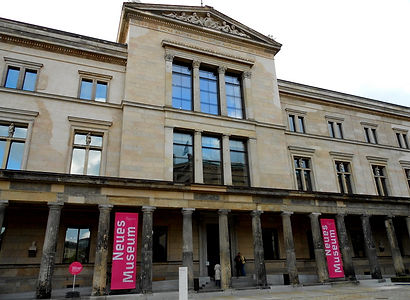
I would like to express my heartfelt thanks and gratitude to Dr. Helmut Satzinger, Professor of Egyptology, University of Vienna, Former Keeper of the Egyptian and Near Eastern Collection, Kunsthistorisches Museum, Vienna, who so kindly devoted his time and effort during my visit to the Museum.
All photographs were taken by Lenka Peacock in 2011 and are © Neues Museum.
I would also like to thank Jan Kunst from Holland for his constructive comments, corrections and additions to the following text, and to Ingeborg Waanders, also from Holland, for her expertise, support and encouragement.

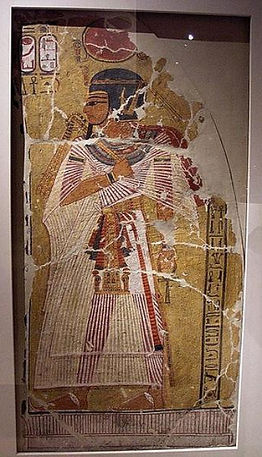
Representation of the deified queen Ahmose-Nefertari
New Kingdom, 20th dynasty, 1152-1145 BC
From Thebes, Inherkau's tomb TT 359 at Deir el-Medina
Painted plaster
Inv.-No.ÄM 2060
Ahmose-Nefertari wears a flowing, pleated dress, typical in representations of elite women of the Ramesside period (about 1295-1069 BC) rather
than the period during which the Queen was alive. On her head she wears the vulture head-dress of the goddess Mut, consort of the god Amun of
Thebes, surmounted by a sun-disc and ostrich plumes. The cobra on her crown and the flail in her hand indicate her royal status. The lotus blossom
was often held by deceased women, thought to be representing rebirth. The black colour of Ahmose-Nefertari's skin does not reflect her true coloration, but may symbolise regeneration.
Representation of the deified Pharaoh Amenhotep I
New Kingdom, 20th dynasty, 1152-1145 BC.
From Thebes, Inherkau's tomb TT 359 at Deir el-Medina
Painted plaster
Inv.-No.ÄM 2061
Amenhotep I is shown wearing a blue cap-wig, with a uraeus on its front. It is topped with a sun-disc. Amenhotep holds a crookand a flail, symbols of royalty, in his right hand. He holds an ankh, symbol of life, in his left hand. The king is shown wearing the classic shendjyt-kilt, and a longer see-through linen garment.
To read more about the cult of the deified couple, follow the link to the Amenhotep temple at Deir el-Medina.

Tomb relief of Khabekhnet in front of royal families
From TT2 at Deir el-Medina
New Kingdom, 19th dynasty, the reign of Merneptah, 1213-1203 BC
Plaster
Limestone
Inv.-No.ÄM 1625
Khabekhnet was the eldest son of Sennedjem (TT1). He lived during the 19th dynasty when Ramesses II (1279-1212 BC) was on the throne. His title was "Servant in the Place of Truth". He lived in Deir el-Medina and worked in the royal tombs at the Valley of the Kings.
Khabekhnet's house was located in the southwestern part of the village. It stood next to thehouse of his father Sennedjem (Théby,2007,276). Khabekhnet was buried along with his wife, Sahte, and their family in a tomb TT2 in the above and slightly to the south of his father's tomb.
Khabekhnet's family was as extensive as Sennedjem's family. A stela found in the courtyard of the tomb contains the names of Khabekhnet, his brother Khons and several children: Mose, Anhotep, Amenemheb, Isis and Henutweret. Benedict Davies suggests they all were Khabekhnet's offspring (Davis,1999,45).
The relief below comes originally from his tomb. It shows Khabekhnet standing in a gesture of adoration on the right in front of a row of deceased kings. The purpose of this relief might lie in the fact, that he could have been responsible for the care of their tombs.

Votive stele of Ta
New Kingdom, 20th dynasty, 1152-1145 BC.
From Deir el-Medina
Limestone
Inv.-No.ÄM 20989
Osiris with a djed-pillar instead of his head
Votive stele of a family praying to Meretseger
From Deir el-Medina
New Kingdom, 18th dynasty, around 1500 BC
Inv.-No.ÄM 24029


Stela of Ubekhet praying in front of the snake
goddess Meretseger
son: Ani-Nakht
From Deir el-Medina
New Kingdom, 19th dynasty, around 1200 BC
Inv.-No.ÄM 21565
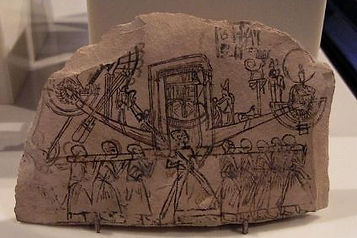
Figured ostrakon
New Kingdom, 19th dynasty, 1292-1187 BC
From Deir el-Medina
Limestone
Inv.-No.ÄM 21446
The drawing represents a procession of a deity in its sacred shrine on a boat equipped with long wooden poles being carried by temple priests. During festivals the gods were taken out of their shrines and temples and their image - shrouded and invisible to the crowds of onlookers - were carried in processions in order to visit the neighbouring sanctuaries. The boats in which the shrines rested were constructed of foreign wood and were embellished with precious metals. The prow of the boat bears the likeness of the deity, in this case the ram's head signifies Amun (Meskell,2004,95-97). The ram is wearing a broad collar around his neck and his head is surmounted by a ureaus within a solar disk. The sacred shrine, which is located centrally on the boat, dominates the deck. The shrine does not seem to be veiled and is open to the view. The portable barque of the god is visible inside and is flanked by 2 protecting deities. The top of the shrine is flat and corniced, surmounted by a cobra frieze. On the prow two deities stand in front of a plumed Wepwawet standard. The deity on the left might represent the goddess Maat as a feather is apparent on her head. A reclining sphinx is placed behind the standard and faces the prow. The scene in front of the shrine is at first glance difficult to understand as it gives the impression that the two figures, standing behind the sphinx and facing the shrine, are interacting with each other. It is the opinion of Jan Kunst, a Dutch Egyptologist, that the impression was created by the fact that the artist run out of space and had to squeeze the figures slightly due to the shortened rendering of the barque dictated by the small size of the ostrakon. According to him both figures represent royal figures, one of a kneeling king (as often can be seen on depictions of the barque of Amun) and behind that a standing king offering a round jar (perhaps a nu jar containing milk or wine) in his outstretched arms. He concludes that similar figures - most likely wooden statues of the king that adorned the actual barque of Amun - were intended on this ostrakon.
The drawing looks like a skillful draft for a larger work. Perhaps this is a study in preparation for a temple wall relief or a tomb painting representing a river barge of Amun. The scene is known from some 16 representations found in different locations around Egypt and ranging in date from the New Kingdom down to Ptolemaic times (Murnane,1979,18). A limestone relief of the Beautiful Festival of the Valley, found within the enclosure of the Temple of Hathor at Deir el Medina, dating from the 1st year of reign of Ramesses II, now in Cairo Museum also carries this image and the ostrakon might be a draft for the relief similar to this one.
In this relief a similar scene of the barque of
Amun is shown on the East side of the South wall of the Hypostyle Hall at Karnak. The king is shown offering the contents of a jar to the statue of Amun, which is placed inside the shrine. The goddesses Maat and Hathor stand on the prow.


Ostrakon with king on his throne
New Kingdom, 19th dynasty, 1192-1186 BC. From Deir el-Medina
Limestone
Inv. No. ÄM 21446
Ostrakon of a man driving a pied bull
New Kingdom, 19th dynasty, 1292-1187 BC.
From Deir el-Medina
Limestone
The body of the man, who walks alongside the small bull, is painted red, his kilt white. The piece is incomplete and the man's head and his right shoulder are missing. The herdsman's right arm rests on the back of the animal while his left hand rests above his head. The animal is
outlined in black and painted mostly black with red markings. The baseline is indicated. The scene is skilfully drawn. It is one of the finest examples of its kind.


Hieratic ostrakon
18th - 19th dynasty, 1540-1186 BC
From Deir el-Medina
Limestone
Inv.-No. P 11253
Four lines in black ink of a hieratic inscription.
"Month 2 of shemu last day of the month, the delay (?) of
a man and another man sanctuary delay (?) 16".
(Tranlated from German translation published at
https://dem-online.gwi.uni-muenchen.de/recherche.php#conErgebnis)
Fragment of a hieroglyphic ostrakon
From Deir el-Medina
20th dynasty, 1160 BC
Limestone
Inv.-No. P 14320
Hieroglyphic draft for an inscription in the tomb of Ramesses IV.

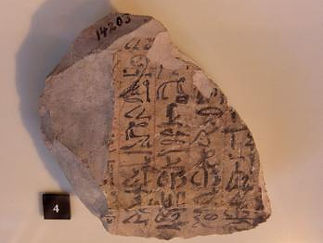
Hieratic ostrakon
From Deir el-Medina
19th dynasty, 1292-1190 BC. Limestone
Inv.-No. P 14203
The fragment of this ostrakon written in hieratic script
preserved a part of a school text called. "Kemyt".
The work named Kemyt (The Compendium), an Egyptian word meaning "what completes, completion", or "what is completed", is mentioned in the 12th dynasty's (circa 1950 BC) The Satire of Trades, so it must be older than that, suggesting Kemyt was a standard text in the 12th dynasty.
The greetings in Kemyt, found at the beginning of a letter it contains, are characteristic of formal letters dated to the 11th dynasty (circa 2000 BC), where the origin can be derived. The surviving copies are written in vertical columns divided by spacing lines, in red paint, rather than in horizontal lines written from right to left, which was the norm during the New Kingdom (James,2003,147-148). The appearance of the signs used is old fashioned, characteristic of early Middle Kingdom period. Why have more ostraka with portions of Kemyt survived than those bearing parts of any other literary text? There might be several reasons for that: the text of Kemyt is not particularly interesting (it is a model letter), so perhaps it was in its simplicity and in its lack of difficulties for the young scribe that it could have been used for scribal beginners. It could have been used as the first reader from which the student learned to handle the hieratic script both in reading and writing.
Thanks to its standard formulae and expressions the exercise was easy to learn and hard to forget making the work ideal for instructional purposes.
Ostrakon with names of kings
From Deir el-Medina
New Kingdom, 19th dynasty, around 1230 BC
Pottery
15 x 10 cm
Inv.-No. O. Berlin P 11235
Acquired by Ludwig Borchardt
This smooth piece of yellowish brown pottery, probably a vessel fragment, is inscribed on the convex side with 5 + 2 lines in black ink. It is broken off at the upper left edge, end of line 1 is lost, line 3 is effaced. After line 5 there are two lines of writing effaced by the scribe.
Classification: account - inventory : deficit
Keywords: grain - oil
Contents: Account of oil and grain. Below: titulary of Ramesses II.
Terminology: ir n (2, 5); wDA.t (1); mn (5); mn.t it (4); gmy.t m
sfT (1); gmy.t m Sbn.w (4); TAy (5)
Names/Titles: Wsr-mAa.t-Ra stp.n-Ra anx wDA snb (nswt-bity,
nb-tA.wy ; king; 5-6
Publication: Deir el Medine online, URL:
http://dem-online.gwi.uni-muenchen.de (photograph, description, transcription, transliteration, translation and commentary)
©1998-2017 The Deir el-Medina Database, Leiden University
http://dmd.wepwawet.nl/


Hieratic papyrus
From Deir el-Medina
Dates attributed: 20th dynasty, year 21 of Ramesses III and year 24 of Ramesses III
Dimensions: 28 x 20.5 cm
Inv.-No. P. Berlin P 10496
Acquired by H. Schäfer in Luxor in 1909
Dates mentioned: rnp.t-sp 21 I Smw sw 7 nswt-bity
Wsr-mAa.t-Ra Mry-Imn anx wDA snb (recto 1); rnp.t-sp 24 I Smw sw 30 (verso 6)
This is a small dark brown papyrus inscribed on the recto with 17 lines in black ink and on the verso with 15 lines in black but beginning of verso 6 in red ink. Verso 15 (docket) is written upside down along the lower edge. Top recto = bottom verso. The papyrus is damaged - first half of recto 15-17 and verso 1-3 are now lost.
Contents: A committee inspecting the tomb of the workman 2a-m-Nwn found that it could be reached through the (nearby) tomb of the workman Imn-m-Ip.t (the speaker). The latter was asked to open his tomb. When inspected, it turned out that this tomb contained an uninscribed coffin. The matter was settled by an oath (by Imn-m-Ip.t ?). Three years later, Imn-m-Ip.t had a quarrel about his tomb with the workman Wn-nfr, who was accused of throwing the 'mistress' of Imn-m-Ip.t (i.e. the mummy of a female ancestor?) out of the tomb. This matter was also settled by an oath.
Names and titles mentioned in the text: an. (pA HoA anx wDA snb ; verso 1); an. (Pr-aA anx wDA snb ; king; verso 4); an. (tAy=i Hnw.t ; f.; verso 10); Imn (deity; verso [1]); Imn-m-Ip.t sA Ra-mry (rmT-is.t ; verso 6); Imn-m-Ip.t (rmT-is.t ; recto 5); Imn-ms (verso 9); Imn-nxt (sS n TAty ; recto 7, verso 8); Imn-nxt (sS ; recto 2, 5, 17, verso 13); Imn-xa (idn.w ; recto 3, 5-6, verso 9); In-Hr-xa (idn.w ; recto 2-3, 6); In-Hr-xa (aA n is.t ; verso 8; cf. 2a ); ax-p.t (sS ; recto 16); Wn-nfr sA Pn-Imn (rmT-is.t ; verso 7); Wn-nfr (sS ; recto 2); BAk (verso 10); BAk-n-wrnr (rmT-is.t ; recto 10); PA-bAk (verso 13); Nfr-Htp (AT.w ; recto 6, verso 14); nswt-bity Wsr-mAa.t-Ra Mry-Imn anx wDA snb (king; recto 1); 1r sA 1y-nfr (recto 10); 1sy-sw-nb=f (rmT-is.t ; verso 8); 2a (aA n is.t ; verso 13 - for In-Hr-xa ); 2a-m-Nwn (rmT-is.t ; recto 4 - written 2a-Nwn ; 11 - no title); 2nsw (aA n is.t ; recto 2, 11, verso 7-8, 13) Incomplete: [...] (sS ; rt. 17)
Text is related to the British Museum ostrakon EA 5624 and and ostrakon in the Archaeological Museum in Florence O. Florence 2621.
Publication of the papyrus:
1. Allam: Hieratische Ostraka und Papyri, 277-280 (no. 265), pl. 80-83 (photograph, transcription, translation and commentary);
2. Blackman IN: JEA 12 (1926), 177-181 (translation, commentary);
3. G. Burkard, H. Fischer-Elfert: Aegyptische Handschriften 4 (Verzeichnis der orientalischen Handschriften in Deutschland XIX, 4), Stuttgart 1994, 67, no. 92 (description; transcription and transliteration of recto 1 and verso 14);
4. Erman: Zwei Aktenstücke ... , 331-336, 339-347 (transcription, translation, commentary);
5. Helck: Materialien III, 348 and 349 (translation recto 1-14 and verso 6-12; commentary);
6. Kitchen. K.: Ramesside Inscriptions V, 476-478 (transcription);
7. Wilson IN: JNES 7 (1948), 139, nos. 57 and 58 (translation verso 1-5 and 11-14; commentary)
(Description and other additional information accessed from the Deir el-Medina database of the Leiden University at http://www.wepwawet.nl/dmd/scripts/dmdobj.asp?id=P.%20Berlin%20P%2010496)

Ancestral bust
Possibly from Deir el-Medina
New Kingdom
Limestone with traces of pigment
Inv.-No.ÄM 20994
Face features are carefully modelled with some paint remainig. The tripartite wig is painted. The front bears a hieroglyphic inscription mentioning the goddess Hathor with her title. There are a few gouges on the body and its face.

77 examples of anthropoid or ancestral busts have been revealed during excavations at Deir el-Medina, further 11 busts are
attributed to the site by their owners or dealers or can be connected to Deir el-Medina on stylistic grounds, and 3 more busts that were in the Luxor and Cairo antiquities markets in 1934-1935 (probably originating from Bernard Bruyère's excavations) that are now lost (Keith,2011,8-9).
The busts generally do not bear inscriptions, only 5 bear signs. Typically small, they measure from 10 to 25 cm in height and
are made of limestone or sandstone. We can assume that most were originally painted as remains of pigment on some are evident. The gender of the most of the busts is open to question (Janssen,2007,187).
The figures are referred to as 'ancestor busts'. It is thought that they were placed in the small shrine areas which seemed to form part of private homes, and played a part in the private devotions of the family. Five busts were found in houses at Deir el-Medina, where they could have been placed in wall niches in the first and second rooms. The wall niches are comparable in size, so this seems probable. Rather than representing anyone in particular, the busts anonymous nature suggests that they represent all the ancestors whom the family might wish to commemorate. Another theory is that they represent "the able spirit" of those, who had been authoritative in life, by inference, the older members of the community. In troubled times people turned to them for help, i.e. to a parent still remembered, not to an ancestor of long ago. Some of these must have been older women.
Similar objects have been found at fourteen other sites from the central Delta to the Third Cataract. They were found in or near houses as well as in tombs and temples. Whether the context was domestic or religious we cannot be sure, but it is understood that for the worshiper the ancestor busts conjured up memories of a deceased relative.
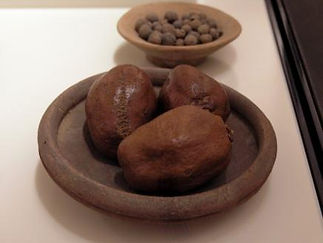
Doum-palm nuts
From Deir el-Medina
These 3 nuts come from a tree called doum palm ("hyphaene thebaica") which only grows in Upper Egypt, specifically in the region to the south of Abydos.
Numerous depictions on the tomb walls from the New Kingdom show the tree, whose fruit was among the items wanted by the deceased. The fruits of the palm have been found in many tombs, from as early as the Predynastic Period.
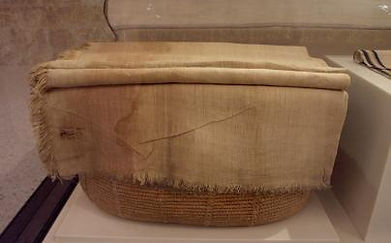
Basket with linen
New Kingdom, 1540-1075 BC
From Deir el-Medina
Basketry, linen
Inv.-No.ÄM 20995
Inv.-No.ÄM 7243
Folded linen, stained
Two well-preserved pairs of sandals meant for a child
From Deir el-Medina
New Kingdom - Late Period, 1540-332 BC
Vegetable fibres, leather
Inv.-No. ÄM 10824/1,2
Inv.-No. ÄM 20998

In ancient Egypt a wide variety of materials - mainly organic (vegetable fibres, leather, wood) - was used to make footwear. There were various types of vegetable fibres such as palm leaf and fibre (the leaf sheath of a palm leaf), halfa grasses and reeds. Leather was oil-cured to make the skin durable. In earlier times sinew was used for sewing the parts together and later on flax was used but also, on a limited scale, leather thongs were employed. Scenes in tombs sometimes show leatherworkers making sandals they pull the strap through the sole with their teeth, put skin in vases with oil to make the skin durable or men are shown cleaning the skin. The production of fibre footwear is never shown. Some people believe that, therefore, it might have been a household activity. Scenes of sandalmakers are shown as part of a larger composition: a leather workshop where also other objects were made, such as chariots and weaponry (Veldmeijer,2014,18-19).
1. Sewn sandals
Distinction is beeing made between three types of Sewn Sandals: type A, B and C. This pair represents the so-called A-Type: the soles are symmetrical or near-symmetrical lengthwise, thick and the number of transverse bundles is low (< 30).
Both sandals have twelve transverse bundles (the front and especially the back one have a substantially smaller diameter),
which are sewn in a fairly regular way. The transverse rows are finished with an edge, which is made in the same technique,
i.e. a fibre core, which is wrapped and sewn with palm leaf strips. The triple edge is of unequal diameter - theouter one
being the thinniest. The straps are incomplete, but enough is preserved in situ to see that there were back and front ones.
2. Leather composite sandals
This is a well-made pair of sandals, which consist of several sole layers. The leather is coloured in bright hues - mainly red and green - and the dorsal surface of the sole and the straps are decorated. The heel is rounded and the waist is constricted. From here, the width increases towards the front almost equally until, approximately, the first quarter of the length. Here, the lateral edge continues with a wider curve towards the big toe area. The treadsole is fairly thick. The straps are mainly in place.

Painted terracotta jug with handles
From Deir el-Medina
18th-19th dynasty, 1550-1187 BC
Pottery
Height: 25.5 cm
Inv.-No. ÄM 21327
Painted clay vessel with motives of ornaments, flowers, mimusops fruits, wreaths/collars and a checkerboard pattern.
Sources:
1. McDowell, A.G.: Village life in ancient Egypt : laundry lists and love songs
Oxford : Oxford University Press, 1999.
2. Meskell, Lynn: Object worlds in ancient Egypt : Material biographies past and present
Oxford : Berg, 2004.
3. Théby : město bohů a faraónů = Thebes : city of gods and pharaohs / Jana Mynářová & Pavel Onderka (eds.)
Praha : Národní Museum, 2007.
4. Davies, Benedict G.: Who's who at Deir el-Medina : a prosopographic study of the royal workmen's community
Leiden : Nederlands Instituut voor Her Nabije Oosten, 1999
5. Murmane, William J.: The bark of Amun on the third pylon at Karnak. IN : Journal of the American Research Center in Egypt, Vol. 16,(1979), pp.11-27.
6. James, T.G.H.: Pharaoh's people : scenes from life in Imperial Egypt
New York : Tauris Parke, 2003.
7. Keith, Jean Lewis: Anthropoid Busts of Deir el Medineh and Other Sites and Collections : Analyses, Catalogue, Appendices / with contributions by Sylvie Donnat, Anna K. Stevens, Nicola Harrington
Le Caire : Institut Français d'Archéologie Orientale, 2011
8. Janssen, Rosalind and Janssen, Jac. J.: Growing up and getting old in ancient Egypt
London : Golden House Publications, 2007.
9. Veldmeijer, André J.: Footwear in Ancient Egypt: the Medelhavsmuseet collection Varldskulturmuseerna
Stockholm : National Museums of World Culture, 2014
http://www.egyptian-museum-berlin.com/index.php
http://dem-online.gwi.uni-muenchen.de/index.php
http://www.hethert.org/beautifu.html
http://www.wepwawet.nl/dmd/scripts/dmdobj.asp?id=P.%20Berlin%20P%2010496
bottom of page