top of page

Sources:1. Borla, Mathilde : Les Statuettes Funéraires du Musée Égyptien de Turin In: Dossiers d'Archeologie
2003
2. KMT, vol. 14, pt. 1
3. Meskell, Lynn: Intimate archaeologies : the case of Kha and Merit. IN: World Archaeology, Vol. 29,
No. 3, Intimate relationships (Feb. 1998), p. 363-379.
4. Shaw, Ian, Nicholson, Paul: British Museum dictionary of ancient Egypt
London: British Museum Press, 1995.
5. Reeves, Nicholas: Ancient Egypt : the great discoveries : a year-by-year chronicle
London : Thames & Hudson, 2000.
6. Vassilika, Eleni: The tomb of Kha : the architect
Torino : Fondazione Museo delle Antichita Egizie, 2010.
7. Russo, Barbara: Kha (TT 8) and his colleagues : the gifts in his funerary equipment and related
artefacts from Western Thebes
London : Golden House Publications, 2012.
8 https://arxiv.org/ftp/arxiv/papers/1107/1107.5831.pdf
9. Raffaella Bianucci, Michael E. Habicht, Stephen Buckley, Joann Fletcher, Roger Seiler, Lena M.
Öhrström, Eleni Vassilika, Thomas Böni, Frank J. Rühl. "Shedding New Light on the 18th Dynasty
Mummies of the Royal Architect Kha and His Spouse Merit", in PLOS-One, July 22, 2015
http://journals.plos.org/plosone/article?id=10.1371/journal.pone.0131916
Images of Deir el-Medina:
past & present
Inherkhau's tomb TT 359 at Deir el-Medina
The owner of tomb 359 at Deir el-Medina was Inherkhau, who lived in the settlement during the 20th dynasty reigns of Ramesses III and Ramesses IV.
"Until May 2014 the tomb was closed for restoration. The work included the consolidation of the walls and paintings. Cracks were repaired, colours were made more vivid and a new lighting system was installed".
From: Betz, Raymond: What's new in Luxor: Pack your bags now! In: Ancient Egypt: The History, People and Culture of the Nile Valley. Volume 16, Number 3, Issue No. 93, Dec 2015/Jan 2016, pp. 42-43.


All photography on the page © 2009 Mutnedjmet
The ceiling of the first chamber of the tomb - the front vaulted upper chamber - is composed of various highly coloured patterns of intricate petal designs, repeated designs of rosettes and spirals intertwined with the two names of the tomb owner Inherkhau and his wife Wabet. (Treasures, 352)
The niche on the south-west wall of the first chamber contains a representation of Inherkhau and his wife Wabet in the pose of worship. On the back wall of the niche there is a representation of Anubis watching over the necropolis in the form of a black jackal with a red ribbon around his neck, reclining on a mastaba and holding the sekhem-sceptre between his front paws and the flagellum between his back paws.

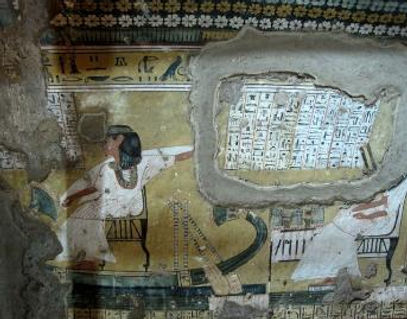
The north-west wall of the first chamber - upper register Inerkhau is depicted sitting on a chair in a barque whose stern and the prow both end in the shape of a lotus flower. The Wedjat eye, symbolising protection, strength and perfection, is painted on the hull on either side of the chair. The deceased, dressed in a white linen costume typical of the 19th dynasty, wears a multicoloured pearl necklace and a garland of flowers and leaves around his neck. His wig is topped by a headband. He has a short, square beard. Inherkhau's arms are outstretched and a large piece of white linen is stretched behind his back, held by each hand - a gesture for which we have no good explanation.
North-west wall, lower register: Each of these scenes depicts Inherkhau and his wife as the recipients of ritual acts and ceremonies performed by priests and their family members.
from The Lost Tombs p. 59
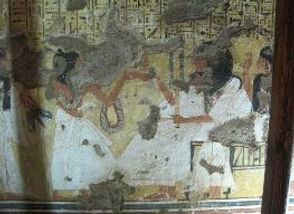


Lower register: Relatives offer
libations to the deceased couple

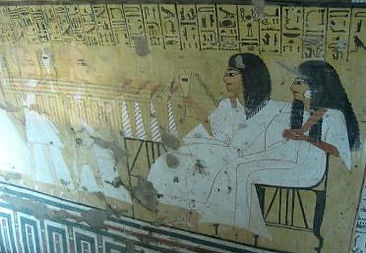

A blind harpist sings to the chief workman
Inherkhau and his wife Wab in this detail
from their tomb. The text of the harpist's is written in the columns of hieroglyphic text behind the behind the harpist (only part visible here). here). The text of the song - McDowell pp. 125-6
Middle register: Inherkhau, in an immaculate white linen costume, performs an act of worship before the souls of Pe, a mythical city in Lower Egypt. The three kneeling genies are incarnations of Horus, Imsety and Hapy. (Treasures 333)
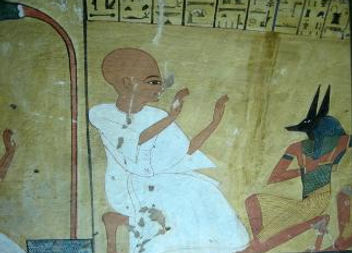

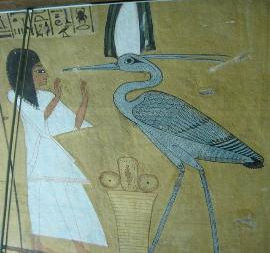
Inherkhau stands before an offering table
worshipping the sacred benu-bird of Heliopolis. The
bird wears the crown of the god Osiris to show its
connection to the god who was believed to be the
spirit of both Re and Osiris.
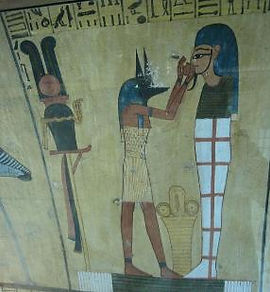
Anubis, the jackal-headed god of the dead, offers a heart to the mummy of the deceased. For the ancient Egyptians, the heart, rather than the brain, was believed to be the seat of their wisdom and the centre of memory and emotion, and was kept in the body after mummification. Behind Anubis is the standard of Osiris, Lord of Abydos.
Inherkhau kneels in worship of the god god Horus in the form of a falcon. Both the pedestal on which the falcon stands as well as its plumage are detail and show great artistic skill.

The sacred cat of Heliopolis, associated with the centre of the cult of the sun god Re, kills the evil serpent Apophis under the ished/persea tree. This symbol of chaos had to be ritually killed every day as the sun god's barque passed through the underworld.


End wall: Inherkhau and his son
worship Ptah and Osiris in a double
scene

Upper register: Inherkhau adores
the horizon

Lower register: Inherkhau is
seated before before his relations
carrying a snake rod


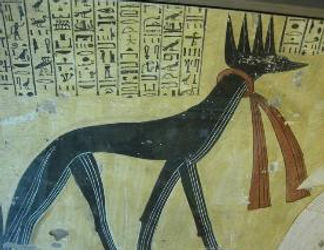
Inherkhau worshipps four jackals
Adoration of a serpent


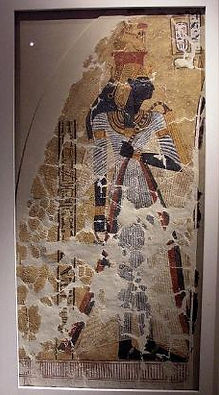

Representation of the deified
king Amenhotep I and his mother
Ahmose-Nefertari
From Deir el-Medina, TT359
Now at the Neues Museum, Berlin
AM2060, AM2061
Sources:
1. Betz, Raymond: What's new in Luxor? : Pack your suitcase now! In: Ancient Egypt : The history, people and culture
of the Nile Valley. Vol. 16, No. 3, Issue No. 93, Dec 2015/Jan 2016, pp. 42-43.
2. Davis, Benedict G.: Genealogies and personality characteristics of the workmen in the Deir el-Medina community
during the Ramesside period. Thesis submitted in accordance with the requirements of the University of Liverpool for
the degree of Doctor of Philosophy
Liverpool : University of Liverpool, February 1996.
3. Davies, Benedict G.: Who's who at Deir el-Medina : a prosopographic study of the royal workmen's community
Leiden : Nederlands Instituut voor Her Nabije Oosten, 1999
4. Dodson, Aidan - Ikram, Salima: The tomb in ancient Egypt : royal and private sepulchres from the early dynastic
period to the Romans
London : Thames & Hudson, 2008.
5. Hawass, Zahi: The lost tombs of Thebes : Life in paradise.
London : Thames and Hudson, 2009.
6. Shaw, Ian, Nicholson, Paul: British Museum dictionary of ancient Egypt
London: British Museum Press, 1995.
7. Strudwick, Nigel and Helen: Thebes in Egypt : a guide to the tombs and temples of ancient Luxor
London : British Museum Press, 1999.
8. The Treasures of the Valley of the Kings : tombs and temples of the Theban west bank in Luxor
Cairo : The American University in Cairo Press, 2001.
9. Weeks, Kent R.: The treasures of Luxor and the Valley of the Kings
Cercelli : White Star Publishers, 2005
On-line resources:
1. http://www.ifao.egnet.net/bases/archives/bruyere/?sujet=Tombes+359%2C360%2C361+Anherkhaoui.+Qaha.+Houy&os=0
2. http://www.osirisnet.net/tombes/artisans/inerkhaou359/e_inerkhaou359_01.htm
bottom of page